"The sea, once it casts its spell, holds one in
its net of wonder forever."—Jacques Cousteau

Nov. 3 - Iron Mountain Trail

"The best views come after the hardest climbs." - Author Unknown
We woke to a beautiful day and decided to hike a trail that would give us views of the area. We chose the Iron Mountain Trail that began on Crystal Park Road, just a few miles from our house. 

It was a 2.7 mile out and back trail with a 600' elevation change. The hardest part of the trail was at the beginning where you scramble up the hillside to an existing small dirt road. 

Once the trail leveled out we passed a Medicine Wheel with a great view of the Garden of the Gods. In fact we had wonderful views of Colorado Springs and Manitou Springs all along this trail. The true pay off of this hike was the 360 view from the summit of Iron Mountain. I read that this trail is fairly new and there was once a home on the top of this peak

The trail map from Crystal Park Road to Iron Mountain.
The beginning of the trail.
Looking east toward Red Rock Canyon Open Space
The Medicine Wheel, sometimes known as the Sacred Hoop, has been used by generations of various Native American tribes for health and healing. It embodies the Four Directions, as well as Father Sky, Mother Earth, and Spirit Tree—all of which symbolize dimensions of health and the cycles of life. Each stone has a purpose and you can read more about at this link.
Looking out at the Garden of the Gods.
The trail
Iron Mountain - There are two trails that lead to this peak. The bottom trail in this picture leads back to Manitou Springs.
Enjoying our views from the top of Iron Mountain.
Pike's Peak is just visible under the clouds.
Panoramic views from the top...looking east to west. 
We could look down into Manitou Springs and see our house. The green arrow points it out.
Looking east at part of the trail around the mountain.
Starting back down the mountain...ready for lunch.
We enjoyed shrimp and fish tacos at the Crystal Park Cantina...both were very good.
I found a picture of the house that once sat at the top of Iron Mountain. They definitely had a wonderful view of the area.
We could see Iron Mountain from our balcony at the apartment.

Nov. 1 - Hiking in Cheyenne Cañon

“Climb the mountain so you can see the world, not so the world can see you.” ~David McCullough

There are hundreds of hiking trails in this area of Colorado, so picking just one to do was a little difficult. I did research on many hikes in North Cheyenne Cañon south of Manitou Springs. There were several we wanted to do, but the closure of the North Cheyenne Cañon Road left us only the Seven Bridges Trail we could get to. I guess being here in the off season means putting up with some inconveniences.


The Seven Bridges Trail is an out and back trail that follows the South Cheyenne Creek. The hike begins on a former narrow gauge railroad bed used to haul gold ore from Cripple Creek to Colorado Springs for processing. The true trail begins in about 3/4 of a mile where it crisscrosses the creek over a series of seven bridges. The creek runs through a rugged canyon and offers lots of places to wade in the water during warmer months. The high canon walls were beautiful. We enjoyed the hike and truly like trails that follow a creek, but it looked a lot like the ones we do in New York. We were hoping to do a hike that would give us views of the surrounding mountains and Colorado Springs.

  
Some of the views we enjoyed on our way up to the trailhead. Can you see the snow on the left side of the pine trees?
One of the two tunnels we drove through coming up the mountain. 
The trail map. The hike was right at four miles with an elevation change of 995'.
The bed of the old narrow gauge railroad is now called Gold Camp Road. It was an easy start to our hike.
The beginning of the Seven Bridges Trail.
Bridge #1
Bridge #2
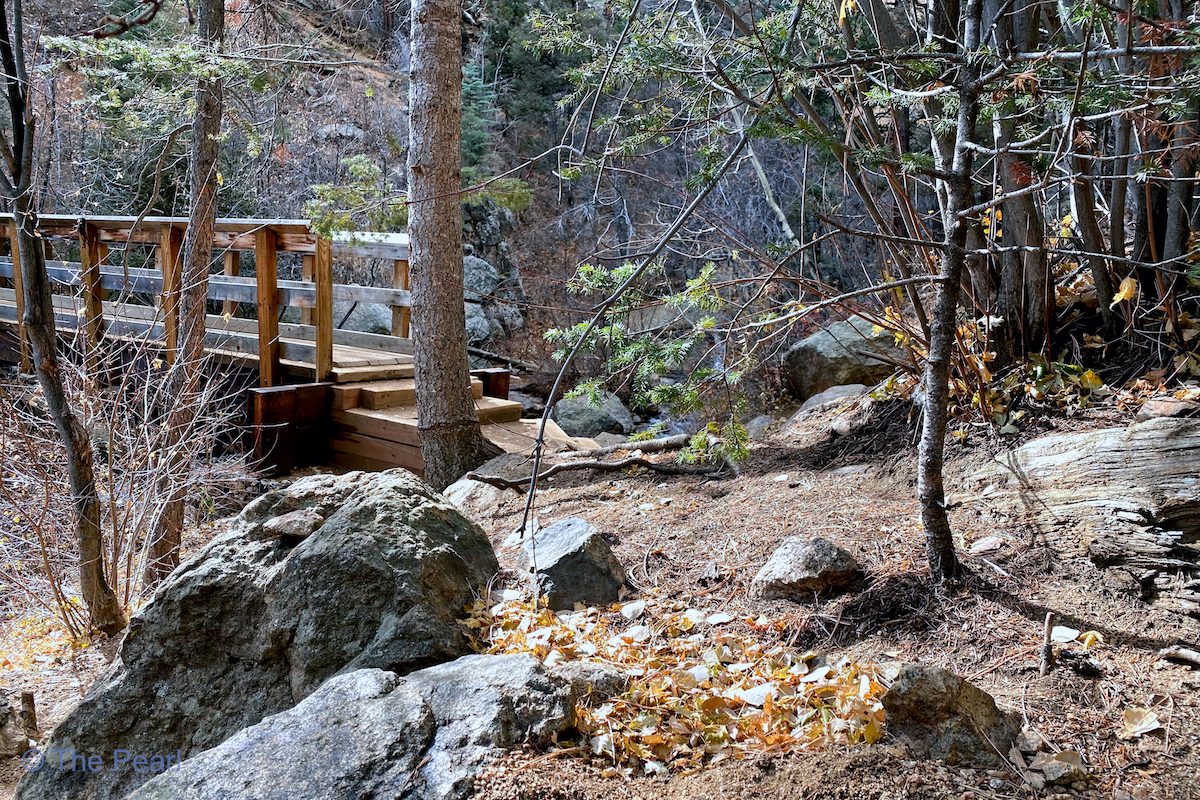
There were beautiful views everywhere along the trail.
Bridge #3
The South Cheyenne Creek
Bridge #4
Bridge #5
Part of the trail.
Bridge #6
Bridge #7
We took a break just beyond bridge seven to enjoy some trail mix. A few visitors joined us for a snack. Both the Steller's Jay and the chipmunk liked our peanuts.
 I think this little guy was collecting food for the winter.
One of our views on our way back to Manitou Springs.
Looking down to Colorado Springs.

Manitou's Mineral Springs

“Doing what you like is freedom, liking what you do is happiness.” ~Anonymous
The mineral springs in Manitou Springs are a vital part of what makes this area special. There are eight distinct naturally-carbonated mineral springs in town and each has a slightly different taste. While we wandered through town we looked for each one and had a little taste...I thought they all tasted about the same.

The source of these famous mineral waters lies deep underground in a system of cavernous aquifers. As the ancient water erodes the surrounding limestone, carbonic acid is created, which gives the Manitou springs their effervescence. This natural carbonation forces the water back to the surface through cracks in the rocks, where it absorbs high concentrations of sodium bicarbonate (soda) and other minerals, including Lithium!

7 Minute Spring gets its name from the fact that when it was drilled, it produced a “geysering event” every seven minutes. It has the lightest, least mineral taste of all of the springs and is located near a gazebo in 7-Minute Spring Park.  
Shoshone Spring came highly recommended by early physicians for its high mineral content and curative powers. The water boasts the highest mineral content of any of the downtown springs and has a very strong, but not unpleasant mineral taste.
Navajo Spring is now located beneath a popcorn and candy store, where it still provides sweet soda mineral water to all who stop by. This spring has a salty, bubbly taste, second lightest after the 7-minute spring. Once the most popular spring in Manitou. This sweet-tasting water became so popular that it was used in beverages made by the Manitou Mineral Water Company, including their world-famous Manitou Ginger Champagne and other popular cola drinks.
Cheyenne Spring is a sweet soda spring, and tastes the best of the mineral springs in Manitou. It’s also one of the oldest in the area, dating back 20,000 years. This spring is among the highest in both magnesium and potassium content, both essential minerals for a healthy body and brain.  
The Wheeler Spring was created in 1920 and donated to the city by the family of Jerome Wheeler. This spring is high in copper and has a saltier taste than the other springs.  
Stratton Spring is located at the “Loop”, an old turnaround for the trolley. It was drilled in 1936 by the Stratton Foundation. It’s part of a bronze and stone sculpture of a woman gathering water. The water is very effervescent and has a higher mineral taste than Twin Spring, but less than Shoshone Spring. 
Twin Spring has been known by many names, but one thing that hasn’t changed is its incredible flavor. It originally began as two springs whose waters merged into a single flow. The sweet waters were popular in making lemonade (Manitou Lemonade and Manitou Mojitos). It's the locals’ favorite spring for its sweet taste.   
Iron Spring: Physicians prescribed the waters from the upper Ruxton Creek, known as “The Strongest of Tonics”, to patients for iron deficiencies and other ailments long before this spring was drilled. The original structure still stands today and may be among one of the oldest constructions sheltering a mineral spring in Colorado. It was once the most popular spring in Manitou.