"The sea, once it casts its spell, holds one in
its net of wonder forever."—Jacques Cousteau
Showing posts with label Massachusetts. Show all posts

Aug. 10 - Rockport, MA

Gloucester Town Mooring

"Some people grumble that roses have thorns; I am grateful that thorns have roses." — Alphonse Karr
We took the bus from Gloucester to Rockport today. Cape Ann has a great bus system that makes getting around Essex County very easy. Rockport is a charming little town located at the northernmost tip of Cape Ann peninsula, 37 miles from Boston. The area was settled in 1690, but Rockport wasn’t incorporated as a separate town until 1840 and quickly became the leading supplier of granite. 

We had light rain all day, but even with the cloudy skies and rain we could see how picturesque this little village is. It's no wonder artists have flocked here since the early 1800s. The central and most recognizable structure in town is Motif No.1. It’s a red fishing shack that sits at the end of Bradley Wharf and it's the most painted building in the United State…if not the world. The town offers a variety of things to do…shopping, fishing, swimming, hiking and musical entertainment at the Shalin Liu Performance Center. 

Bearskin Neck is a small neck of land that juts out of the town center into Rockport Harbor. It’s full of quaint little studios, gift shops, galleries, restaurants, and boutiques. Although Rockport boasts a thriving artist community, it remains home to an active fishing fleet, offering visitors a unique chance to observe artists at their craft or lobstermen hauling their traps. 
Motif No. 1 was built in 1840 as Rockport was becoming home to a colony of artists and settlement of fishermen, the shack became a favorite subject of painters due to the composition and lighting of its location, as well as being a symbol of New England maritime life. The original structure was destroyed in the Blizzard of 1978, but an exact replica was constructed that same year. Motif No. 1 is a term used to mock artistic clichés, and Rockport attracted plenty of artists who seized on the cliché of a red fishing shack.  
Believe it or not this isn't even low tide.
By dinnertime the sun was out...these are views from our deck

Aug. 9 – Gloucester, MA

Gloucester Town Moorings

"The ocean is a central image. It is the symbolism of a great journey." —Enya

We're back onboard after a great week visiting with family in Pennsylvania. We started our day early, very early. We pulled away from the dock at 6:00 and stopped at the fuel dock in New Bedford to take on 160 gallons of diesel. That job takes a little time, but we were heading out of the harbor and into Buzzards Bay by 7:00. We had the current giving us an extra push, which made the long 90 miles a little easier.

We caught the current just right to fly through the Cape Cod Canal this morning. The current changes direction every six hours and can reach a maximum speed of 5.2 MPH, during the receding ebb tide, so it’s not something we want to do on the wrong tide. The canal is an artificial waterway crossing the narrow neck of land that joins Cape Cod to mainland Massachusetts. It connects Cape Cod Bay in the north to Buzzards Bay in the south. Using the canal saves boaters about 135 miles by not having to go around Cape Cod. 
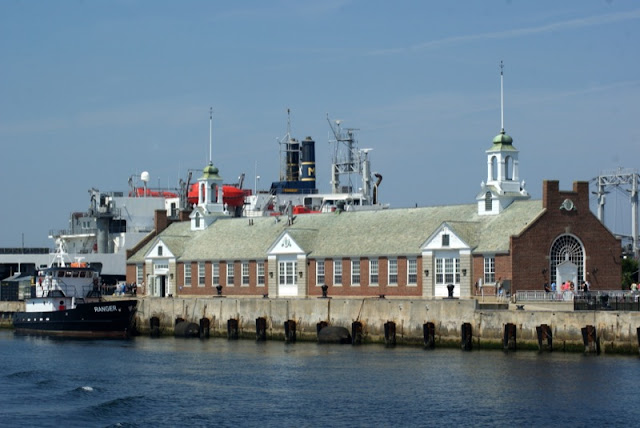
Tonight we are in Gloucester (pronounced Glau'tah). It’s located at the southern end of the Annisquam River on Gloucester Harbor. The town was founded in 1623 and claims to be America's oldest seaport. The town was an important shipbuilding center, and the first schooner was reputedly built there in 1713. The community developed into an important fishing port, largely due to its proximity to Georges Bank and other fishing banks off the east coast of Nova Scotia and Newfoundland. Gloucester's most famous (and nationally recognized) seafood business was founded in 1849, Gorton's of Gloucester. The iconic image of the "Gorton's Fisherman", and the products he represents, are known throughout the country. Besides catching and processing seafood, Gloucester is also a center for fish research. We’ll stay here two nights so we can explore Rockport tomorrow.

The Cape Cod Canal and the Massachusetts Maritime Academy
This beautiful sailboat was fighting the current and not moving very fast
Coming into Gloucester
The Fisherman's Memorial from the water
Gloucester Harbor is a working harbor
The Fishermen’s Memorial sits overlooking Gloucester Harbor. The statue is a tribute to the 10,000 Gloucester fishermen who have lost their lives at sea over the centuries. The names of each of the known lost are listed at the memorial and unfortunately new names are still being added.  

July 28 – Fairhaven, MA

Acushnet Safe Boating Club Marina

“There is only one thing that makes a dream impossible to achieve: the fear of failure.” ―Paulo Coelho

We took it easy most of today. Touring and sightseeing every day can wear you out. We spent a slow morning onboard and then ventured out for a short bike ride to check out Fort Phoenix and the hurricane barrier. The park was full of people wandering around looking at their phones. I guess the area was full of Pokémons and these young people were there to catch them. It made me wonder how crowded it would have been before this latest game became popular.

We walked out on the hurricane barrier and had a great view of the harbor...no people or Pokémons there. On our way back to the boat we stopped at Margaret's for lunch. Everyone at the marina has told us about this place and now we know why...gourmet food and diner prices. Our lunches were wonderful, the best meal we’ve had out in a very long time. We spent the rest of our day onboard trying to stay cool. I watched movies and read while Stan set up his new computer.

Fort Phoenix
Fort Phoenix is an American Revolutionary War-era fort located at the entrance to the Fairhaven-New Bedford harbor. It stands on a granite ledge overlooking Buzzards Bay. It’s now a public park owned by the Town of Fairhaven.

The first naval battle of the American Revolution took place off its shore in May 1775, when the local militia captured two British sloops in Buzzards Bay. Shortly afterward, the town petitioned for the construction of a fort to protect the harbor. The original fort was built between 1775 and 1777 and was outfitted with eleven cannon, several of which had been captured in the Bahamas by John Paul Jones. It was decommissioned after the Civil War.
A view of Fort Phoenix from the water as we came into the harbor on Tuesday. 
A view of Fort Phoenix from the hurricane barrier
The hurricane barrier from the water
The New Bedford-Fairhaven Harbor is protected from tidal flooding associated with hurricanes and coastal storms by a hurricane barrier. It was completed in 1966. The dike is closed a dozen times or more each year for storm events that bring southerly gales and tidal surges, but a closure for a hurricane is rare. The barrier consists of 3.5 miles of dikes and gates, creating a wall roughly 20 feet tall. A 150’ wide opening allows ships to move in and out of the harbor under normal conditions. It’s said to be the largest stone structure on the East Coast and the largest hurricane barrier in the world.   
The view of New Bedford from the hurricane barrier
Looking out to Buzzards Bay...you can see the fog rolling in.
Looking back at Fort Phoenix 
Margaret's, a quaint wood-shingled house that serves up dishes that could pass at some swanky hotel on the Cape.
This is the lunch specials for the day...look at those prices and the prices on their regular menu were just as nice.
My lunch of sautéed shrimp with mushrooms, asparagus and tomatoes in garlic-tarragon butter, with a nest of sweet potato sticks.
Stan lunch was grilled yellowfin tuna with wasabi mashed potatoes, snow peas, grilled red peppers and ginger mango jam.

July 27 – New Bedford, MA

Acushnet Safe Boating Club Marina

“To me the sea is a continual miracle; The fishes that swim–the rocks–the motion of the waves—the ships, with men in them, What stranger miracles are there?” —Walt Whitman

Today we rode our bikes back across the bay to New Bedford to explore the Whaling Museum. We spent most of the morning at the museum, had lunch at Tia Maria, a little European café with a Portuguese influence, and then returned to the museum in the afternoon to finish our tour. It’s a very impressive place and well worth a day's visit. This evening we enjoyed visiting with the friendly people at the marina. This marina is a private boating club that allows a few transients to dock…everyone has been very friendly and gracious, and they’ve gone out of their way to make us feel welcomed.

The New Bedford Whaling Museum opened in 1907 and invites visitors to voyage around the world during the Golden Age of Sail when New Bedford's whaling fleet circled the globe to hunt the giants of the deep for whale oil to light the lamps of the world and lubricate the wheels of the Industrial Revolution. This institution, which was founded by the whaling families of the greater New Bedford area, is now the world's largest and most comprehensive museum devoted to the global story of whales, whaling and the history of Massachusetts' south coast region. 

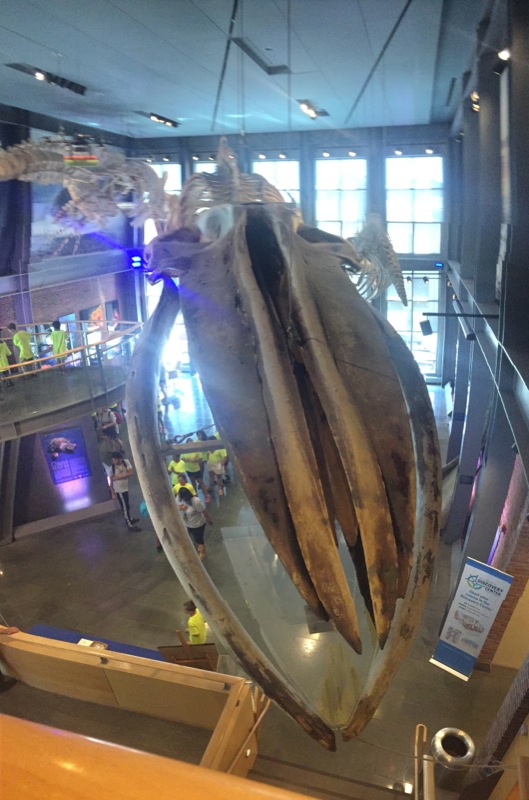
The museum's main campus encompasses a city block overlooking historic New Bedford harbor. Its 20 galleries of maritime art and science exhibits include five complete whale skeletons and the world’s largest ship model, Lagoda, which was built in place 100 years ago. The overall length of the model is 59' with a mainmast 50' in height, she is fully rigged and outfitted for an extended whaling voyage. You can read more about the Lagoda here.

The New Bedford Whaling Museum 
The whales at the museum 
The Lagoda located in the Bourne Building at the New Bedford Whaling Museum
Part of the scrimshaw collection at the museum. These are sperm whale teeth.
Each dot on this map represents a whale taken by a whaling ship that sailed from New Bedford. This is a small section of the large map. 

July 26 – Mattapoisett, MA

Acushnet Safe Boating Club Marina (Fairhaven)

"The simple things are also the most extraordinary things, and only the wise can see them." –Paulo Coelho

Today we took the Phoenix Bike Trail and the Mattapoisett Rail Trail over to Mattapoisett. Mattapoisett became best known as a center for shipbuilding and whaling during the 1700 and 1800s. More than 400 ships were built in the town's shipyards, including the Acushnet, the ship that Moby-Dick author Herman Melville sailed on and later deserted. It’s now a cute little summer vacation spot.

We enjoyed the ride over and then had lunch at The Inn on Shipyard Park. The building was built in 1799 and has served as a blacksmith shop, two separate dwellings, a ship chandler, a storehouse for the China tea trade, a tavern, a general store and a speakeasy. We had a great bowl of clam chowder as we relaxed from our long bike ride and enjoyed the view of the water. We spent the rest of the afternoon watching people in the park and riding out to the Ned’s Point Lighthouse. This has been the warmest day this summer…warmer here than in Texas today, so we were hot and tired when we made it back to the boat. We were definitely glad to be at a dock with the AC running this evening.

Some of the scenery on our way to Mattapoisett
The dinghy dock in Mattapoisett
The Inn on Shipyard
Town Wharf General Store
A quaint little house on the waterfront
The view from Shipyard Park towards Ned's Point Lighthouse 
Ned's Point Lighthouse built in 1838