Maritime Center Marina
“If we were meant to stay in one place we’d have roots instead of feet” —Rachel Wolchin
Charleston is full of history…everywhere you look and every street you go down has a story to tell. One of the most photographed areas of historic Charleston is Rainbow Row. This charming row of colorful homes is a perfect example of the old row houses that were very distinctly Charleston.
Rainbow Row was built in the mid 18th century on East Bay Street. At that time, this was the commerce center on Charleston's waterfront, built to serve the wharves and docks of the very vibrant and busy Port of Charleston. Merchants worked in their stores on the first floor and called the top floors home.
Unfortunately, conditions of these homes were severely deteriorating after the Civil War. In the early part of the 20th century, a woman named Dorothy Porcher Legge purchased some of the homes and began to renovate them. She painted these homes pastel pink, for the popular colonial Caribbean color scheme. Eventually other homes in the row were purchased and renovated and their owners followed her example, painting the homes in different shades of pastel colors.
As with any historic area with lots of character, there are many stories as to the reasons for the different paint colors on Rainbow Row. One story says the houses were painted in different vibrant colors so drunken sailors coming from port would know which house they were supposed to sleep in. Other stories tell of merchants who used different color paints so illiterates would know which store to shop at without having to read the sign. Either way, the results are delightful.
Today, Rainbow Row consists of 14 private residences that are part of one of the most famous architectural landmarks in Charleston.
Charleston’s Rainbow Row
April 21 – Charleston, SC
Maritime Center Marina
“No matter where I go, travel is my destination!” —Anonymous
We spent the day playing...Stan went fishing with Magnus and I went shopping with Charlotte. We all had a great time. The guys caught a lot of fish and Charlotte and I restrained ourselves to just a few purchases. This evening Stan and I enjoyed a visit to Pearlz, but it just isn’t the same without the crews of Amici and Gallivant. The following is a post from our visit in 2013…a little history lesson for the day.
Charleston Single House is a style of architecture in Charleston dating back to the 1720s. Settlers first saw these single house designs in Bermuda and Barbados and adapted them for use in Charleston. The houses were designed to capture as much breeze as possible on the hot and humid summer days. These houses are usually one-room-wide and the narrow end of the house faces the street. Two-story verandas (called "piazzas" in Charleston) stretch down the long side and provided ample outdoor living space and needed cross-ventilation to help cool air circulate through the house. The piazzas also help to shade the windows of the house from the afternoon sun, keeping temperatures inside more livable.
The front doors on the Charleston single house do not open into the house itself, but onto the ground floor piazza. Once on the piazza, there is a true front door into the interior of the house.
A lot of homes in Charleston and in other places in the south paint the ceilings of the porches blue. There are a lot of theories why this is done; the most common reason I've heard is that a blue ceiling is more resistant to spiders, bees, wasps and other annoying insects. In the South Carolina Lowcountry, there's a name for the blue of porch ceilings: haint blue. A haint is a spirit or a ghost, and in Charleston, people also paint the trim on their houses blue to ward off evil spirits. It is believed that the color blue keeps ghosts and evil spirits from getting into the house. There is some debate on whether this practice started in South Carolina or in the bayous of southern Louisiana. Some also say blue helps extend daylight as dusk begins to fall. Whether any of these theories are actually true, who really knows, but it does make the ceiling look nice.
Stan having fun on the water
Magnus and one of his fish
A few examples of Charleston's single homes
April 20 - Charleston, SC
Maritime Center Marina
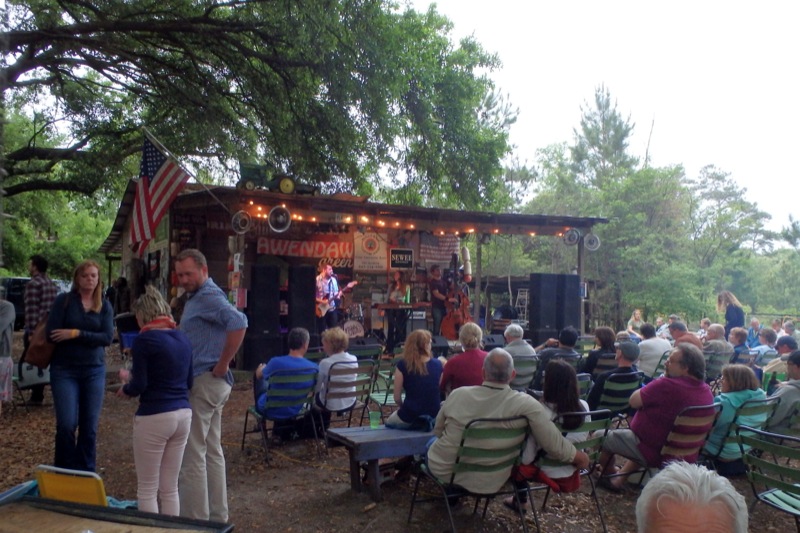
They have concerts here every Wednesday...year round and they feature 5-6 bands each time
There were fire pits to keep everyone warm
“To travel is to take a journey into yourself.” ―Gustave Flaubert
We're back in one of our favorite places. We've spent a lot of time here and love it. While we're here this week I will only be posting the highlights of our day...no time for a long blog. If you are new to this blog you can find out more of what we have done in the past from reading our old blog entries at this link.
We had a short day on the water and were tied up to the dock before lunch. Stan spent his afternoon getting a haircut and foot massage at the Old South Barber Spa. While I did the laundry...he'll be working tomorrow while I go shopping on King Street.
We spent the evening with Charlotte and Magnus at an outdoor concert in the woods near Awendaw, which is just north of Charleston. We took a picnic dinner and a bottle of wine and had a wonderful time. The venue was fun, the music was good and the company was great.
Our first look at Charleston
A great venue for a fun eveningThey have concerts here every Wednesday...year round and they feature 5-6 bands each time
There were fire pits to keep everyone warm
Subscribe to:
Posts (Atom)