"The sea, once it casts its spell, holds one in
its net of wonder forever."—Jacques Cousteau

July 27 – New Bedford, MA

Acushnet Safe Boating Club Marina

“To me the sea is a continual miracle; The fishes that swim–the rocks–the motion of the waves—the ships, with men in them, What stranger miracles are there?” —Walt Whitman

Today we rode our bikes back across the bay to New Bedford to explore the Whaling Museum. We spent most of the morning at the museum, had lunch at Tia Maria, a little European café with a Portuguese influence, and then returned to the museum in the afternoon to finish our tour. It’s a very impressive place and well worth a day's visit. This evening we enjoyed visiting with the friendly people at the marina. This marina is a private boating club that allows a few transients to dock…everyone has been very friendly and gracious, and they’ve gone out of their way to make us feel welcomed.

The New Bedford Whaling Museum opened in 1907 and invites visitors to voyage around the world during the Golden Age of Sail when New Bedford's whaling fleet circled the globe to hunt the giants of the deep for whale oil to light the lamps of the world and lubricate the wheels of the Industrial Revolution. This institution, which was founded by the whaling families of the greater New Bedford area, is now the world's largest and most comprehensive museum devoted to the global story of whales, whaling and the history of Massachusetts' south coast region. 

The museum's main campus encompasses a city block overlooking historic New Bedford harbor. Its 20 galleries of maritime art and science exhibits include five complete whale skeletons and the world’s largest ship model, Lagoda, which was built in place 100 years ago. The overall length of the model is 59' with a mainmast 50' in height, she is fully rigged and outfitted for an extended whaling voyage. You can read more about the Lagoda here.

The New Bedford Whaling Museum 
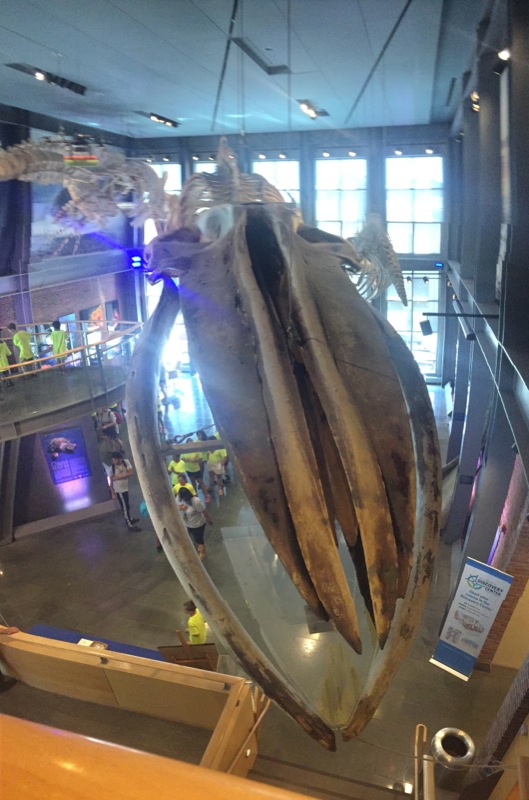
The whales at the museum 
The Lagoda located in the Bourne Building at the New Bedford Whaling Museum
Part of the scrimshaw collection at the museum. These are sperm whale teeth.
Each dot on this map represents a whale taken by a whaling ship that sailed from New Bedford. This is a small section of the large map. 

July 26 – Mattapoisett, MA

Acushnet Safe Boating Club Marina (Fairhaven)

"The simple things are also the most extraordinary things, and only the wise can see them." –Paulo Coelho

Today we took the Phoenix Bike Trail and the Mattapoisett Rail Trail over to Mattapoisett. Mattapoisett became best known as a center for shipbuilding and whaling during the 1700 and 1800s. More than 400 ships were built in the town's shipyards, including the Acushnet, the ship that Moby-Dick author Herman Melville sailed on and later deserted. It’s now a cute little summer vacation spot.

We enjoyed the ride over and then had lunch at The Inn on Shipyard Park. The building was built in 1799 and has served as a blacksmith shop, two separate dwellings, a ship chandler, a storehouse for the China tea trade, a tavern, a general store and a speakeasy. We had a great bowl of clam chowder as we relaxed from our long bike ride and enjoyed the view of the water. We spent the rest of the afternoon watching people in the park and riding out to the Ned’s Point Lighthouse. This has been the warmest day this summer…warmer here than in Texas today, so we were hot and tired when we made it back to the boat. We were definitely glad to be at a dock with the AC running this evening.

Some of the scenery on our way to Mattapoisett
The dinghy dock in Mattapoisett
The Inn on Shipyard
Town Wharf General Store
A quaint little house on the waterfront
The view from Shipyard Park towards Ned's Point Lighthouse 
Ned's Point Lighthouse built in 1838 

July 25 - Fairhaven, MA

Acushnet Safe Boating Club Marina

“Not everything that is faced can be changed, but nothing can be changed that isn’t faced.” –James Baldwin

We’re docked in Fairhaven, which is located across the harbor from New Bedford. This area is rich in history with a port that has changed through the centuries to support a diverse population and make many people very rich.

In the 1800s whale oil lit the world and New Bedford became the greatest whaling port and the richest city per capita in the world. The city's vast fleet of whaling ships plied every ocean in the world and took the American flag into foreign ports for the first time 

By the end of the Civil War whales were becoming scarce and new and cheaper means were being used to heat and light the world’s homes. New Bedford had to find a new why to change with the times. By 1900 the city was the largest producer of fine cotton cloth in the nation and led all centers in quality and quantity output of fine goods. At the height of production it employed over 40,000 people, but through the years this industry has dwindled to oversea markets. 

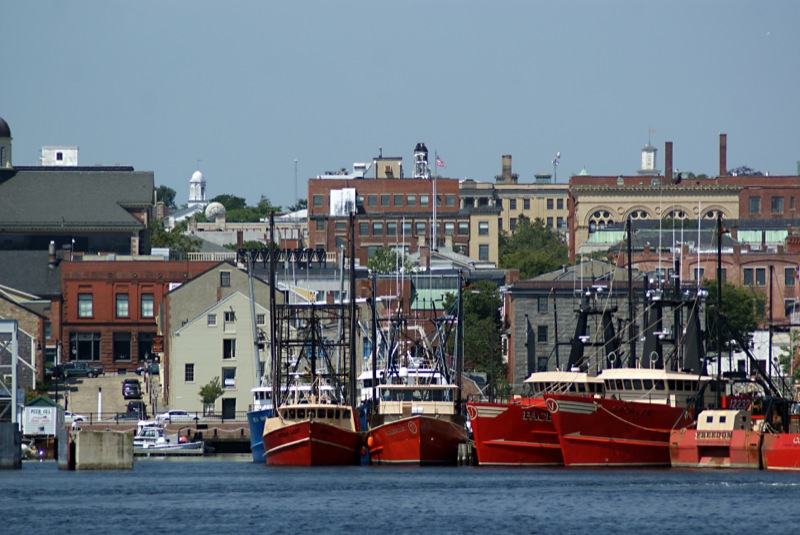
Now New Bedford’s leading industry is fishing and is home to a large fishing fleet. We’ve never seen so many fishing boats in one harbor. It also has one of the nation’s last remaining fish auctions and has numerous other offloading facilities. Vessels from every major East Coast port unload their catch here; including every important commercial species from cod and haddock to sea scallops. During the height of the season, 500,000 pounds of scallop meats cross New Bedford docks in a single day.

Clark's Lighthouse sits atop Fort Taber (Rodman) at the entrance to New Bedford Harbor. Built in 1804
Butler Flats Light is a sparkplug lighthouse located in the outer harbor of New Bedford, at the mouth of the Acushnet River. Built in 1898 
Palmer Island Light Station located in New Bedford Harbor. The lighthouse was built in 1849 out of stone rubble. 
Part of the commercial fishing fleet in New Bedford Harbor
We had lunch here...Freestones City Grill located in an old bank building in the historic part of town.
US Customs House in New Bedford first built in 1836. It is the oldest continuously operating customs house in the United States.
This building was built in 1854 and was originally used as a bank. It has served many purposes through the years, but now it serves as the Visitors center to the New Bedford Whaling National Historical Park.
The New Bedford Whaling National Historical Park encompasses 13 blocks of historic downtown New Bedford...cobble stone street and century old buildings that served the needs of the citizens during the heyday of whaling in New England.
With so much fresh seafood in the area, we decided to have a seafood platter for dinner...salmon, lobster, scallops and a clam stuffie. Definitely the besta we've ever had.