"The sea, once it casts its spell, holds one in
its net of wonder forever."—Jacques Cousteau

April 25 – Charleston Churches

Maritime Center Marina

“You are braver than you believe, stronger than you seem, smarter than you think, and loved more than you’ll ever know.” —A. A. Milne  

Charleston is known as the Holy City because it was one of the few places in the original 13 colonies that practiced religious tolerance. From the beginning, the city was a melting pot for people of all faiths, especially those who had been persecuted elsewhere because of their religious beliefs. Along with religious freedom came a skyline of some of the oldest and most beautiful houses of worship in the country. Here are just a few of the wonderful churches that are in Charleston.

The Circular Congregational Church, the present building, is the third structure to be built on this site, and was constructed circa 1892. In spite of its name, the plan of the church is more complex than circular; shaped like a clover leaf with three semi-circular parts and one rectangular.
Bethel Methodist Church was the only Charleston Historic Church, which remained open during the Civil War, and it survived the earthquake of 1886 intact. Although there have been interior alterations, the exterior has been well preserved. 
St. Philip's Episcopal Church, a National Historic Landmark, houses the oldest congregation in South Carolina and was the first Anglican Church established south of Virginia. This church is the third building to house the congregation; the first church was built in 1681. This building was completed in 1838.  
First Baptist Church, often referred to as the "Mother Church of Southern Baptists," is the oldest Baptist Church in the South, dedicated in 1822. 
This picture was taken from the Internet...I liked it! It shows the Unitarian Church (1787) and St. John's Lutheran Church (1817) 

April 24 - Charleston, SC

Maritime Center Marina

“The traveler sees what he sees. The tourist sees what he has come to see.” —G.K. Chesterton

There is a little known walkway in Charleston, called the Gateway Walk. It connects the Unitarian Church and St. John's Lutheran Church, located along Archdale Street to the Circular Congregational Church on Meeting and St. Philip's Episcopal on Church Street. It’s situated in the historic heart of Charleston and yet off the beaten path, Gateway Walk provides a break from the busy main streets as it meanders through old graveyards and secluded gardens, much of the way is in the quiet shade of moss draped live oaks.

The walk was the first civic project of the Garden Club of Charleston and opened on April 10, 1930 to celebrate the 250th anniversary of the founding of Charleston. Gateway Walk is one of Charleston's best hidden treasures and very pretty on such a nice spring day.

St. John's Lutheran Church - Established in 1742
The Unitarian Church - the oldest Unitarian church in the South
Part of the cemetery at the The Unitarian Church 
The Gateway Walk between the The Unitarian Church and Charleston Library Society 
Circular Congregational Church and Parish House - Organized in 1681, it is one of the oldest continuously worshiping congregations in the South 
A view of St. Phillips from the Circular Congregational Church Cemetery 
Headstones in the Circular Congregational Church Cemetery - these are from the mid 1700s 
Headstones in the St. Philip's Episcopal Church. John C. Calhoun is buried in this cemetery. 

April 23 – Charleston, SC

Maritime Center Marina

"Life isn’t about getting and having, it’s about giving and being." –Kevin Kruse 

We’re having a great time in Charleston and I will do a post next week of the highlights, but for now I’m enjoying a vacation in one of our favorite places and not spending time blogging…so here's a previous blog that was originally posted a few years ago. Enjoy!

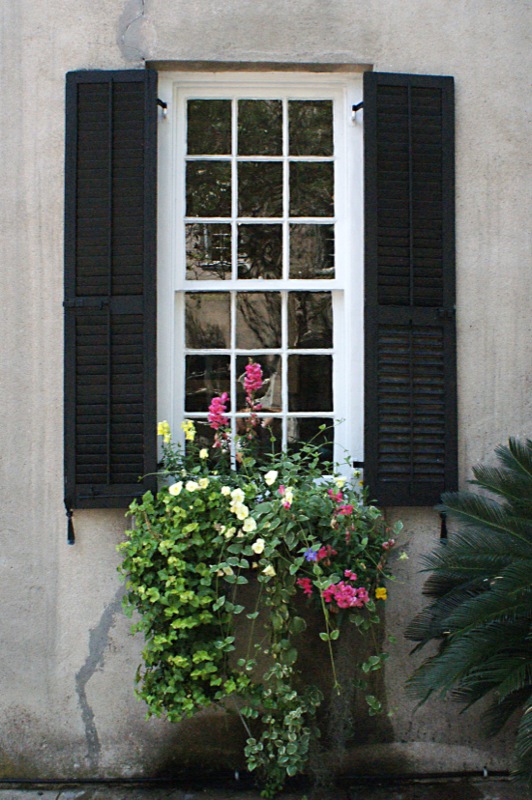
One of the first things you notice while wandering around Charleston, especially south of Broad is the abundance of stunning window boxes overflowing with beautiful flowers on almost all the homes. Many of these homes in the historic district were built during the 1700 and 1800s. These homes were built close to the street, many sharing exterior walls with little green space; therefore planters are the only gardening space available…at least on the front of the home. Although many of these houses have small gardens or patios in the back, hidden from the street.

If you look closely at some of the photos you'll see the boxes have a drip irrigation system, so the owners don’t have to water these window boxes…the secret to why they always look so pretty.

Here are just a few of the wonderful window boxes. If you'd like to see more click here to visit my photo album.