"The sea, once it casts its spell, holds one in
its net of wonder forever."—Jacques Cousteau

Sept. 19 - Montmorency Falls (Part I)

“It is only in adventure that some people succeed in knowing themselves – in finding themselves.” – Andre Gide
We left Québec City this morning and headed east to see Montmorency Falls (Chute Montmorency) and then the Île d'Orléans. This post will cover the falls...I'll do another post for the island. The day started out dreary, windy and cool but began to clear as we enjoyed the falls.

Montmorency Falls is one of Quebec's most spectacular sites. The falls plunge 272' into a bowl-shaped basin on the St. Lawrence River. The waterfall is nearly 100' higher than Niagara Falls, but nowhere near as wide. It can be discovered on foot, by cable car, a zip line or from the gourmet restaurant at the Manor. We parked at the top park, near the Manor and walked across the suspension bridge above the falls, but we read later some people take the cable car up the cliff, do the hike and then go down the 487-step staircase to the foot of the falls. From there you can walk back to the cable car terminal. That would have been fun on a beautiful sunny day, but it was too cold today. 

The suspension bridge gave us spectacular views of the surrounding countryside, although I'm sure the views would have been much better on a clear day. We could see downtown Québec and the Île d'Orléans. I walked down some of the stairs, but quickly decided I didn't need to go all the way down AND back up. The staircase allow you to view the falls from several different perspectives.

The waterfall was first noted by Jean Fonteneau dit Alfonse in 1542, but it was Champlain that named the waterfall after Henri II, duc de Montmorency in 1608. In July 1759, during the campaign to take all French possessions in Canada, British General James Wolfe had a fortified camp near the top of the falls. 

Looking down on the falls from the suspension bridge
Views from the suspension bridge. This is looking over to the Île d'Orléans.
Looking down at the bottom of the park...the cable car terminal is just left of the bridge and the path from the bottom of the falls is to the left. 
Looking towards Québec City and the Manor
The waterfalls from the top of the stairs
Looking down on the stairs...that's a long ways down, especially if you have to come back up.
Cable cars going up to the Manor
A view of the falls from the bottom of the basin...we stopped here on our way over to Île d'Orléans.
A closer look at the staircase
Park map
The park is open year round. When it gets very cold, fine splashes from the falls freeze and eventually form the famous Sugar Loaf, an impressive cone of ice at the foot of the waterfall. 

Sept. 18 - Old Québec, QC

“The pleasure we derive from journeys is perhaps dependent more on the mindset with which we travel than on the destination we travel to” – Alain de Botton

Our last day in Old Québec was cold and windy, not a good day to be outside, but it gave me a chance to do a little shopping. Since it was a dreary day and not a good day for taking pictures I thought I'd share more pictures from our first two days in Old Québec. I think we walked up and down every little cobblestone street (Rue) in town...at least once. I'm in love with this city.

A few of the streets in Upper Town. This is Rue des Jardins, just around the corner from our loft.
Bellos Restaurant on Rue Saint Louis
Rue Saint Anne (just down the street from our loft). It's a picturesque pedestrian street with colorful bistros, boutiques and craft stalls.
Rue de Trésor is just off Rue Saint Anne. During the French Regime, settlers would come to the Royal Treasury Office here to pay their taxes. Now it's a bustling open-air art gallery.
Rue Saint Jean is full of cafés, restaurants, bars and shops. It's one of the most popular streets in Old Québec.
Cote de la Farique begins at the end of Rue Saint Jean
Notre-Dame-de-Québec Basilica located at the end of Cote de la Farique. The church was built in 1647 under the French Regime. The cathedral has since been expanded, bombarded and burnt to the ground. In 1925 it was rebuilt according to the original plans.
Steps are not the only way to get from Upper Town to Lower Town, you can take the Old Québec Funicular. It's a railway that links the Haute-Ville (Upper Town) to the Basse-Ville (Lower Town). Climbing at a 45-degree angle, the railway covers a total distance of 210 feet. The funicular was first opened on 1879 and has since been totally revamped with modern technology. 
Views from the Funicular 
The following streets are in Lower Town. This is Rue Sous le Fort looking up at the Funicular.
Rue Sous le Fort with a view off the Funicular and the Château Frontenac in the background.
 Rue des Paines Bénits close to Place Royal
A view of Québec City's Old Port from the wall on the east side of town. This area has been a hive of activity, from its heyday in the 19th century as one of the world's five biggest ports to its status today as a popular cruise destination.
Looking out of one of the windows in the old wall towards Québec City's Old Port.
Terrasse Dufferin is a beautiful terrace along the St. Lawrence River built 1879. It's located just below the Château Frontenac. The walkway offers spectacular views of the St. Lawrence River. Formerly a military fortification, it's now a public park.
View from Terrasse Dufferin of Lower Town.
One afternoon we walked The Governors Promenade, it's a giant boardwalk that connects the Plains of Abraham Park to the Dufferin Terrace. The elevated promenade stretches along the Citadel with the fortification wall on one side and a gorgeous view of the St. Lawrence River on the other.
Views from the promenade. This is looking east towards Montmorency Falls and Pont de I'ile Bridge that leads to Île d'Orléans. Both places we visited before coming home. (Blogs to follow)
Looking towards Île d'Orléans with the Québec City-Lévis Ferry in the foreground.

Sept. 17 - Old Québec, QC

It's a pretty good life I'm living, you won't hear me complain. I'm just hoping tomorrow I get to do it all over again. –Howard Livingston
Old Québec...what an amazing place to visit. I think we'd like to return and spend a month just hanging out at the little sidewalk cafés and wandering around at a slower pace. The city made all our senses think we're in France, with the sight of winding cobblestone streets and century old buildings, the sound of French pleasantries, the taste of buttery croissants and the enticing smell of fresh-baked bread and amazing chocolate. It's a little piece of Europe right here in North America.

For the most part we had amazing weather while we were in Quebec...sunny and warm until our fourth day when a front moved in. One day we were in shorts and the next we were layered up trying to stay out of the wind. We knew the weather was going to change so we saved shopping for that day...well shopping for me and resting for Stan. One thing for sure, you need to be in good shape to really enjoy Old Québec. We spent our time wandering up and down every little street, learning about the 400 years of history of the city and taking in the amazing views at every advantage point we could find.

Château Frontenac is one of Canada's grand railway hotels, built in 1893. It's perched atop a tall cape overlooking the Saint Lawrence River and has a spectacular view. It's said to be the most-photographed hotel in the world. 
Porte St. Jean is the northernmost gate into the Old City and is one of  two main town gates originally built in 1694. It has been rebuilt through the years, the present gate was built in 1939. 
Porte St. Louis is the gate closest to the Citadel also built 1694. It has also been rebuilt through the last 300 years. The present gate was built in 1878. 
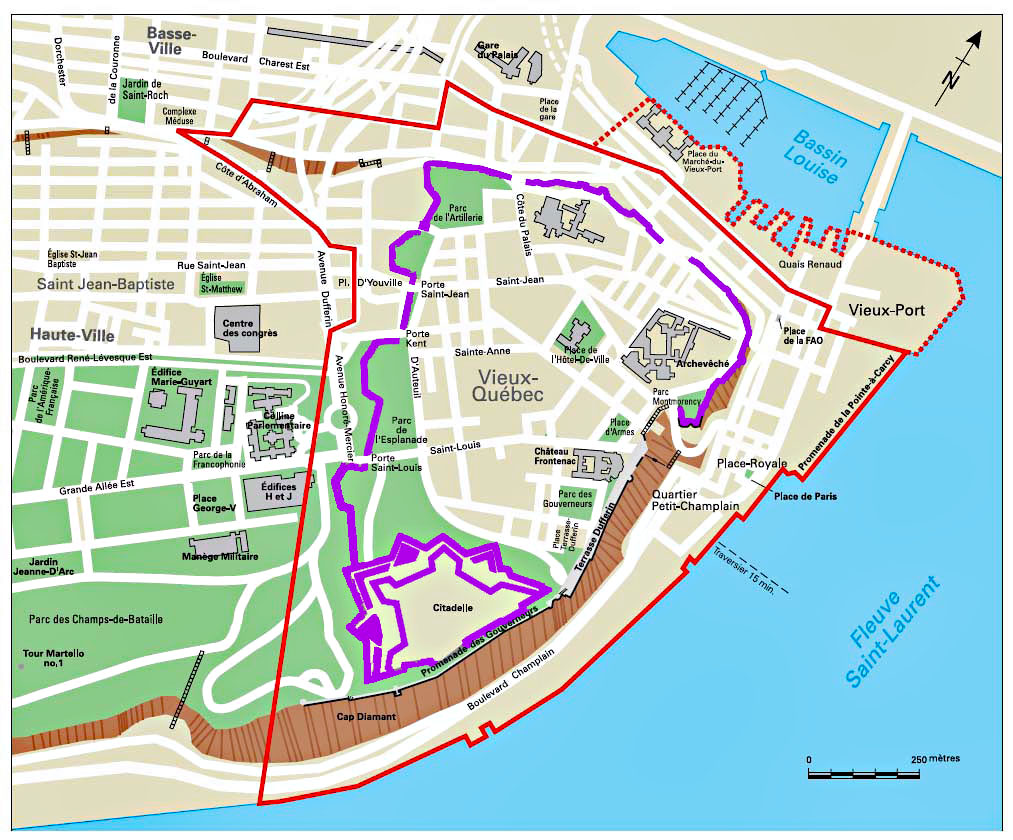
You can walk the whole fortification wall around Old Québec, we did parts of it. The fortifications were developed between 1608 and 1871, erected under both French and British regimes. The English began fortifying the existing walls after they took command of Quebec City in 1759.   
Here is a map showing the fortification wall...it's the purple line
The City Hall of Québec City (Hôtel de ville de Québec) is located in the heart of Old Quebec, just across the street from our loft. It was inaugurated on September 15, 1896. The building slopes downward because it was built on a hill.
Looking down to Quartier Petit-Champlain. It's the oldest shopping district in North America and is known as one of the most beautiful sites of Old Québec. It's located at the bottom of the cliff under the Château Frontenac. The pedestrian streets offer a variety of interesting boutique shops and cozy cafés located in restored houses. It was my favorite neighborhood in the city. This is looking down from the Breakneck Staircase.
Looking back at the Breakneck Staircase. It's the oldest staircase leading down to the lower town. It dates back to 1635. The current staircase was built in 1968. Québec City boasts nearly 30 sets of stairs that link the Upper Town with the Lower Town. As I said...you need to be in shape to really enjoy this quaint old town.
Quartier Petit-Champlain 
Quartier Petit-Champlain Fresco - Illustrates the lives of the residents of the Cap-Blance district, as well as the bombardments, landslides and other major events that have occurred here.
Rue Cul de Sac used to run alongside the first port of New France. This little street was the Port du Cul-de-Sac. Now it's full of little bistros.
Looking up Rue Cul de Sac at the Château Frontenac. We had lunch one day at the little bistro to the right.
Notre-Dame des Victoires is one of the oldest churches in North America. It was built atop the ruins of Champlain's first outpost. Construction was completed in 1723, but rebuilt in 1763 after being destroyed by the British bombardment in 1759. It sits in Place Royal.
The inside of Notre-Dame des Victoires. The small vessel hanging from the ceiling is thought to be a miniature of the "Brézé". The model was found in 1759 after the church was destroyed. It was preserved and placed in the museum of Quebec Seminary and Laval University until 1954 when it was returned to the church.
Place-Royale is considered to be the birthplace of the French colony and the French-American community. During the 17th and 18th centuries, this area of Old Québec acted as the French colony's center of business and industry, supporting a thriving marketplace and housing many wealthy merchants. 
Mural of Quebecers - It depicts 400 years of Québec City history. 
La Vivrière - is a fountain sculpture commemorating the founding of the Food and Agriculture Organization of the United Nations (FAO) in Québec City in 1945. Installed near the docks, this monument evokes both the history of the port of Québec and the city’s centuries-old relationship with the St. Lawrence River.