"The sea, once it casts its spell, holds one in
its net of wonder forever."—Jacques Cousteau
Showing posts with label California. Show all posts

Sea Glass & Glass Beaches

"One man's trash is another man's treasure..."

Through a little research I’ve read there is a difference between sea glass and beach glass. Sea glass refers to salt water glass and beach glass refers to fresh water glass. The difference being that glass slowly dissolves in salt water, which gives sea glass a satin-like patina, while it does not dissolve in freshwater. Long ago stories were told that these types of glass were “Mermaid Tears”. It was said that every time a sailor drowned at sea, the Mermaids would cry and the sea glass was their tears washing up on the shore. 
Sea and beach glass can be found everywhere in the world, because people have used the oceans and other bodies water to dispose of trash. It was natural for waterfront communities up until the mid 1960’s to discard their trash in the water because the water carried it away. A hundred years ago landfills were considered a health hazard, filled with rats that carried diseases.  

Sea Glass value is partially determined by its color. Red, blue, lavender, purple and pink are rare because fewer items were stored in containers made of these colors. Cobalt Blue, the "sapphire" of the beach, came from such apothecary items as Milk of Magnesia, Vicks Vapor Rub, Noxzema, Nivea, and Bromo Seltzer bottles, along with some prescription bottles. The extremely rare red pieces, or "rubies" of the beach, may come from perfume bottles, the tail lights on old automobiles, lanterns and traffic light lenses. Gemological terms like "inclusions", "clarity", "color", "facets" and "purity" also relate directly to sea glass, except that inclusions and "impurities" are a good thing in sea glass.  

Pinks, lavenders, purples, lime greens and other rare shades came from things like perfume bottles and art glass. Some lavender and pink glass were originally clear, but over time the sun causes the magnesium and selenium in the glass to oxidize, creating these pretty colors. I seem to find these colors easier in Texas where the sun is more intense and the weather hotter.
Glass beaches (the kind found in Fort Bragg, CA or on Kauai) are close to areas that were originally used as dumps, but sea glass can also be found on lots of other beaches because of storms, dumping from ships and glass that is drawn off the beach by the sea and distributed by the "longshore currents". The best beaches to find sea glass are those where few people can get to, beaches accessible only by boat. 
There are three Glass Beach sites in Fort Bragg where trash was dumped into the ocean between 1906 and 1967. Site Two (1943-1949) and Three (1949–1967 - "Glass Beach") are located at the end of the path that begins on the corner of Elm Street and Glass Beach Drive. These sites are accessible by foot and a short climb down the cliffs that surround the beach. Between 1,000 to 1,200 tourists visit Fort Bragg's glass beaches each day in the summer. Most collect some glass. Because of this and also because of natural factors, the glass is slowly diminishing.  

Oct. 15-16 – Northern California

“Instead of wondering when your next vacation is, maybe you ought to set up a life you don’t need to escape from.” —Seth Godin

We spent our last two days of our Pacific adventure driving down the California coast and winding our way through part of the Redwood Forest. It was a beautiful countryside, where the mountains meet the ocean. The roads twist and turn around and over the mountains, producing wonderful vistas of the valleys and ocean. We visited several more beaches including a glass beach and stopped at a few of the large redwoods to take pictures.

Our final destination was Los Gatos near San Jose. We drove by vineyards and small ranches on our way towards San Francisco and Berkeley…beautiful countryside on a beautiful day. We spent our last afternoon doing a little shopping in Los Gatos and enjoying the company and hospitality of our daughter in-law's grandparents. It was a fantastic vacation, we saw a beautiful area of the country plus we got to enjoy some delightful time with family. It’s definitely a place we will visit again.

Redwood Forest in Northern California
We found bigfoot!
 The countryside around Anderson Valley in northern California

Yosemite's Curry Village

“Once you have traveled, the voyage never ends ... The mind can never break off from the journey.” —Pat Conroy

When I called last summer for a reservation in Yosemite, all the lodges in the Valley were full. So I decided we’d rough it a little and stay in one of the historic tent cabins in Curry Village. We didn’t mind our accommodations…even though we had to walk to the shower house. The biggest drawback was the invasion of Jr. High school kids, there to take part in the Nature Bridge program…over 400 hundred of them. The evenings and early mornings were very loud and the showers were very crowded. Even with the small inconveniences we really enjoyed staying in the park and being able to take the bus to trailheads and other places so easily. We definitely want to come back to do more exploring.

Curry Village History:
Camp Curry began in 1899 when two school teachers, David Curry and Jenny Etta Foster (later known as Mother Curry), opened a tented camp. They wanted to provide accommodations that were less expensive than the hotels but offered more services than the campgrounds. They advertised "a good bed and clean napkin with every meal" for $2 a day (equivalent to $57 in today's dollars). It was developed in the early 20th century as a camp concession for tourists to the park. Today the Camp Curry complex is listed on the National Register of Historic Places and its accommodations include 18 hotel rooms, 60 cabins and 424 canvas tent cabins. In 1970 the community changed its post office name to Curry Village.

Significant structures that still exist include the 1914 entrance sign, the 1904 Old Registration Office; the 1913 dance hall, now adapted as guest lodgings known as the Stoneman House; the 1916 Foster Curry cabin, and the 1917 Mother Curry's bungalow. Bungalows with en-suite baths were built from 1918 to 1922, and bungalows without plumbing were built during the Great Depression of the 1930s. The best thing about staying in Curry Village is the incredible views of Half Dome and Glacier Point. What an awe inspiring way to wake up in the morning.
Our home in Yosemite Valley 
More tent cabins at Curry Village
Our morning view on the way to breakfast
This old lodge is used as the Internet Cafe...a busy place.
More shots of our morning views.

Oct. 7 - Last Day in Yosemite

"We must take adventures, in order to know where we truly belong." – Unknown

Today was our last day in Yosemite. We had a nice breakfast at the Dining Pavilion and then packed up and spent our last morning taking in the wonderful views of the park from the north road. We had two great days of hiking and saw the highlights that Yosemite has to offer. We’d like to come back, maybe next time we can come in the spring when there is water in the falls.

In 1864 President Abraham Lincoln declared Yosemite Valley and the Mariposa Grove of giant sequoias a public trust of California. This marked the first time the U.S. government protected land for public enjoyment and it laid the foundation for the establishment of the national and state park systems. It became a national park in 1890. The park became a World Heritage Site in 1984.

The spectacular scenery was largely created from glacial activity 2 to 3 million years ago. The scraping of ice over the landscape produced the many waterfalls, U-shaped canyons and the iconic mountain. Rock falls, some triggered by earthquakes, others perhaps by water seepage turning into ice have also helped shape the area. The winding path of the Merced River has helped to carve out the valley floor.

Yosemite Facts:
  • Yosemite Falls at 2,425 feet, nearly half a mile, is the tallest waterfall in North America. When it peaks in May, Yosemite Falls shakes the ground. 
  • Bridalveil Fall, while thundering in May, grows gentle later in the year, waving in the breeze like a veil.
  • Yosemite Valley is seven miles long and a half-mile wide.  
  • Yosemite covers 747,956 acres and is known for its waterfalls, giant granite cliffs and stunning sequoias.
  • There are 840 miles of trails to hike in Yosemite National Park.
  • The mountains located in Yosemite still grow about one foot every 1,000 years. 
  • Half Dome is 8,842 feet high. It is the youngest peak in Yosemite.
  • El Capitan, which has a 3,300-foot rock face, is the largest visible block of granite in the world.
  • Highest peak is Mt. Lyell at 13,114 feet.
  • 20% of California's 7,000 plant species are found within Yosemite.
  • There are 500 giant sequoias in Yosemite, which can live up to 3,000 years. 
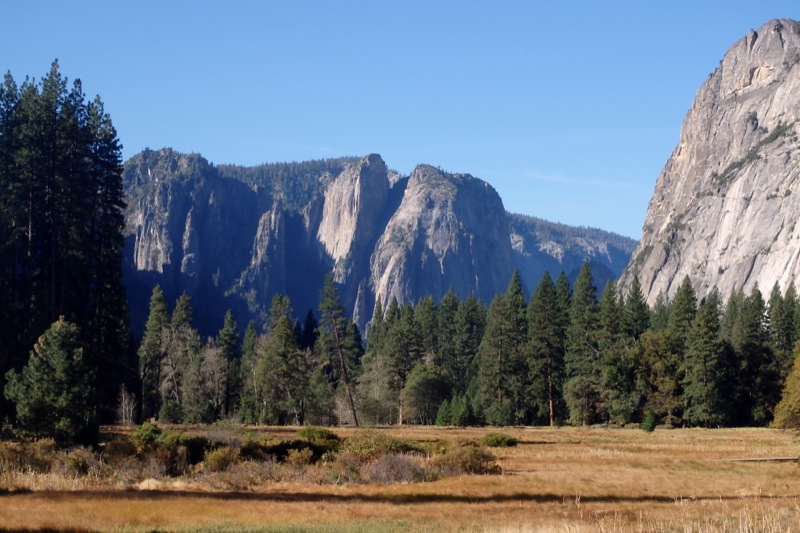
Cathedral Rock
Yosemite Falls - The dark line on the cliff (middle of the photo) is where the water should be running.
El Capitan at 3000 feet above the Valley floor is the largest monolith of granite in the world.

Cathedral Rock and the Merced River
Valley View of El Capitan and Merced River from Northside Drive
Valley View of El Capitan, Cathedral Rock, Merced River on our way out of the park
Yosemite Valley and Bridalveil Fall from Big Oak Road with the Merced River trickling down the middle

Oct. 6 – Yosemite National Park

Curry Village

"Travel as much as you can. As far as you can. As long as you can. Life’s not meant to be lived in one place." – Unknown

One of the most popular hikes in Yosemite takes you up to Vernal Fall and Nevada Fall where the Merced River "stairsteps" toward the valley floor (Mist Trail). The two falls flow all year with peak flows in May and June. The trail to Vernal Fall isn't that long, only 2.4 miles around trip, but it climbs 1000 feet from the trailhead at Happy Isles to the top of The fall. The last few hundred meters are 600 stairs cut into the cliffside. We didn’t do the hike all the way to Nevada Fall, but did follow the river about ½ mile up the canyon before making our way to the trailhead. We had lunch near the river with a wonderful view of Liberty Cap. 

This is Yosemite's signature hike. While many of Yosemite's trails are popular due to having a single spectacular destination, the Mist Trail has fabulous views scattered all along the way, beginning at the bridge overlook, progressing to two unforgettable waterfalls that fall a combined total of more than 900 feet, and incredible views of Liberty Cap, Mt. Broderick and Grizzly Peak. 

The trail started out nice and easy
View on the way up
These pictures were taken yesterday from Glacier Point
Nice bathrooms at the base of the falls...before the real climb began
Going up!
Views of the fall about half way up
The last climb to the top
Views of the trail from the top
We made it
Lunch view
Emerald Pond above Vernal Fall
Mt. Broderick and Liberty Cap
On the trail to Nevada Fall - Liberty Cap
On our way down